Garage Openers
 Garage Springs
Garage door R-value vs U-factor: the key difference
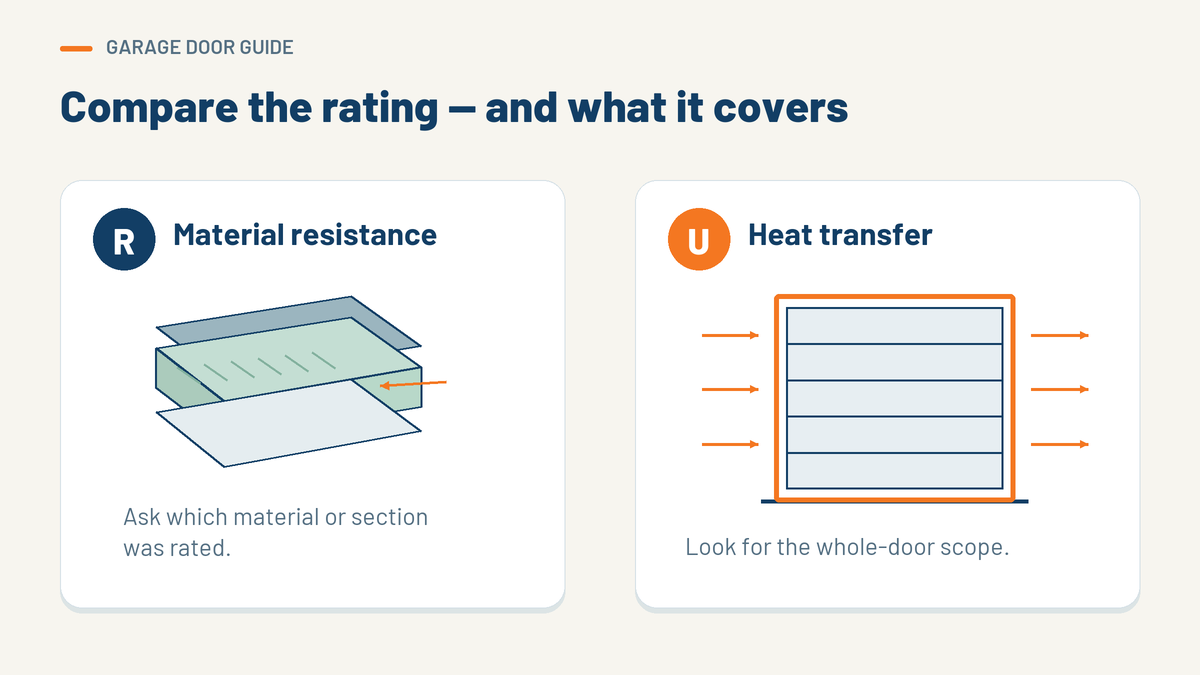
Garage door R-value vs U-factor is a comparison of thermal resistance and heat transfer, but the part of the product being rated matters just as much. Higher R-value means greater resistance to heat flow for the material or assembly described. Lower U-factor means less heat transfer for the assembly described.
Garage door brochures commonly list a calculated insulation or door-section R-value alongside a tested whole-door U-factor. Those numbers do not necessarily cover the same thing. Before choosing an insulated garage door, ask whether the rating describes a section, a complete door or the specific configuration you plan to buy.
Read insulated garage door ratings on the same basis
Insulated garage door ratings are useful when their scope and test basis are clear. They become misleading when a strong result for one component is presented as proof of performance for the entire installed opening. When an insulated garage door specification lists R-value, check if it describes just the door section. For U-factor, check the tested assembly and product configuration. Compare like-for-like door size, glazing and seals when discussing insulated garage door installation.
| Rating or detail | What it helps explain | What to ask |
|---|---|---|
| R-value | Resistance to heat flow for the stated material or section. | Is this a core value, section value or assembly value? |
| Whole-door U-factor | Heat transfer through the tested door assembly. | Which model and configuration were tested? |
| Air leakage | Air movement through gaps and joints under stated conditions. | What separate leakage information is available? |
| Windows and seals | Features that influence the completed opening. | Does the quoted rating reflect the chosen options? |
For example, a high section R-value alone does not prove that one door outperforms another door with a documented assembly rating. Collect comparable information before ranking the two.
Why whole-door U-factor matters
Whole-door U-factor accounts for the tested assembly rather than only the center of its insulation. Door construction includes section joints and other details that cannot be represented by looking at foam thickness alone. A tested assembly result is therefore useful when comparing complete products.
DASMA’s Thermal Performance Verification Program provides a way to identify participating products and review listed thermal performance. Look for the program identification for the actual model, not simply the manufacturer’s name. Participation does not mean every product or every optional configuration has the same rating.
Ask the supplier to identify the relevant listing or specification and explain any difference between the rated specimen and your order. If a quote provides only R-value, request the available whole-door data rather than inventing a missing number.
Do not turn a section rating into a whole-door claim
Thermal resistance and transmittance can have a reciprocal relationship when they describe the same assembly on the same basis. That does not justify dividing one by a brochure’s insulation R-value and labeling the result a tested whole-door U-factor.
The practical rule is simple: keep the manufacturer’s stated rating, scope and method together. If two quotes use different measures, ask for comparable documentation. A supplier should be able to explain what a number includes without asking you to treat unlike ratings as interchangeable.
Likewise, avoid assuming the highest rating creates a specific indoor temperature or energy-bill reduction. The rest of the garage, outdoor conditions and how often the door opens all affect the outcome. A door rating is product information, not a personalized building-energy calculation.
Air leakage, windows and installation still matter
Air leakage is a separate concern from heat passing through the door’s materials. Visible perimeter gaps, damaged seals and poor fit deserve attention even if the insulated sections have an impressive R-value. A better core cannot close an opening left at the bottom or sides.
Our garage door bottom seal vs threshold guide explains two different approaches to the floor edge. Neither should be treated as a substitute for finding why a door sits unevenly or fails to close correctly.
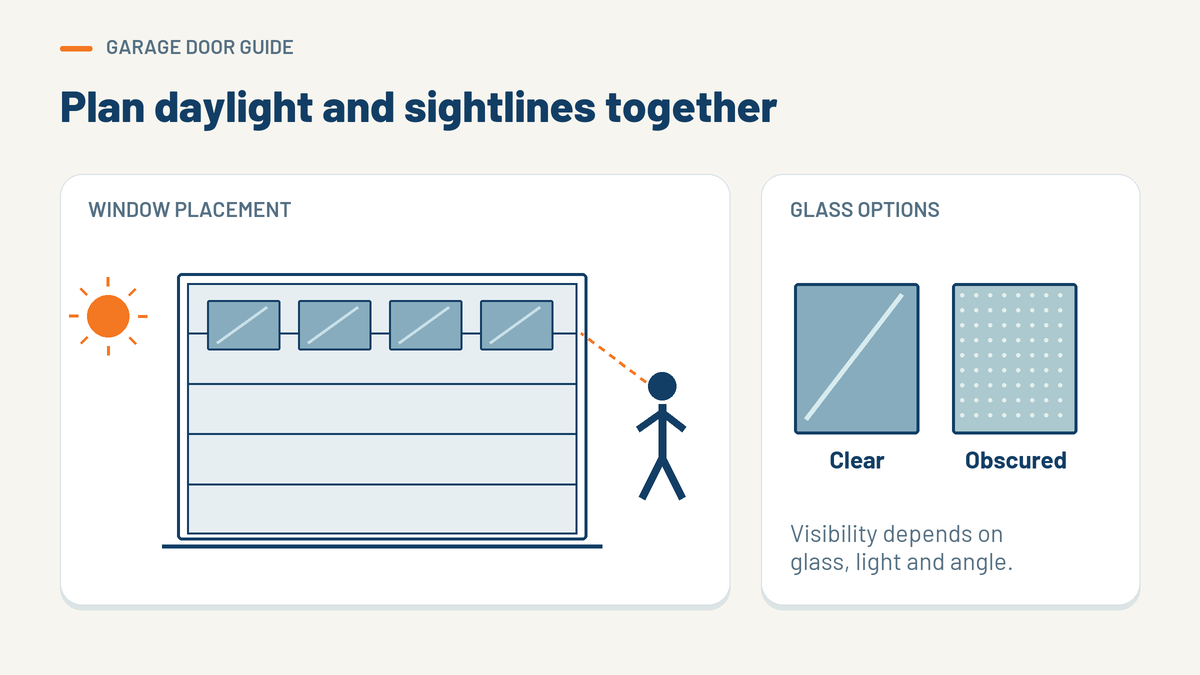
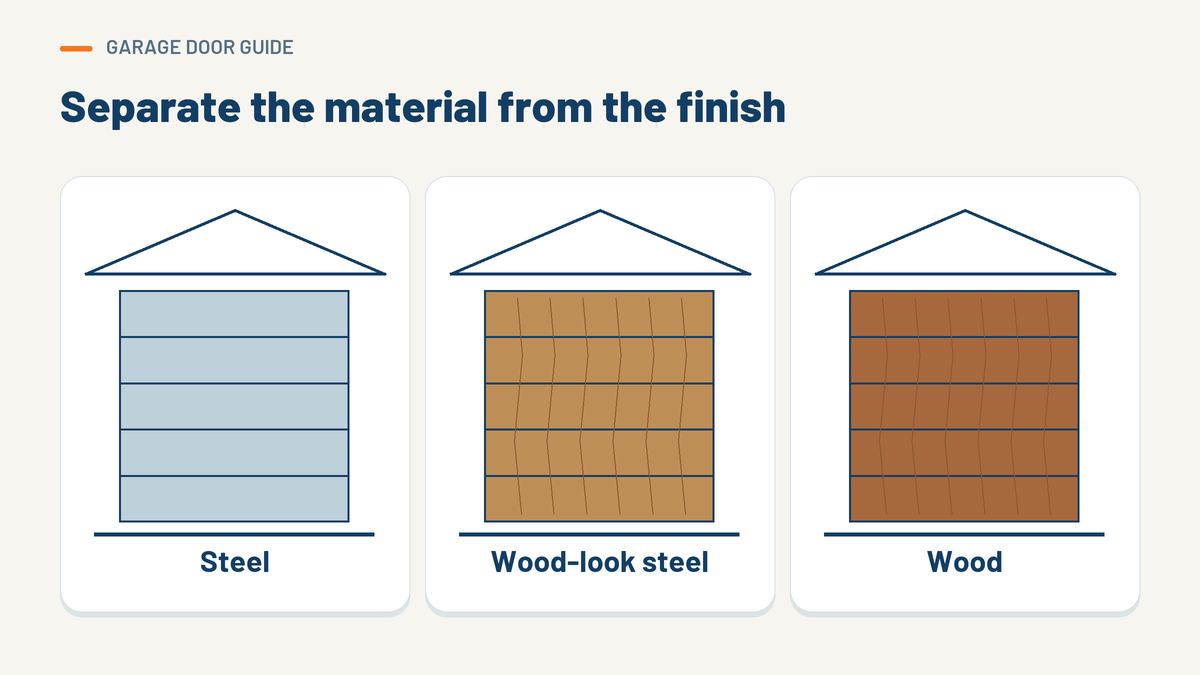
Glazing is another reason to compare the final configuration. Review garage door windows and glass options before ordering, then ask which thermal data apply to that choice. Similarly, steel vs wood garage doors is a construction and upkeep decision; a material name by itself is not an insulation rating.
Match the insulation decision to how you use the garage
Begin with your goal. For an attached garage, describe any comfort concerns near shared rooms and the condition of the boundary between garage and house. For a detached garage, explain whether it is primarily parking, storage or a regularly used workspace. These details help frame the decision without promising that a new door will solve every temperature problem.
Compare quotes using the same door size, construction, window choice, rated configuration and sealing scope. Ask what existing components will be replaced and whether the selected door requires different supporting hardware. Do not add weight to an existing door as an insulation experiment without a compatibility assessment.
If the current door still functions well, our repair vs replacement guide helps separate a maintenance problem from a reason to replace the assembly. For garage door replacement, request a complete specification with the available thermal documentation. That is a stronger basis for choosing than the largest number on a sales sheet.